A homeowner calls after staring at six warm-white chips for a week. She wants a painting estimate, but she also expects the painter to choose the wall color, settle the trim white, and tell her whether the sofa makes one option look too yellow. The person answering the phone has to sort out two services before putting anything on the calendar.
Start with one direct question: “Do you already have approved colors, or are you asking for help choosing them?” Then clarify whether your company offers color advice, who provides it, what the consultation covers, and what the customer must approve before paint is ordered. Capture the rooms, paint surfaces, fixed finishes, light, photos, decision-maker, preferred consultation format, and deadline. That record keeps a request for design help from arriving as a vague estimate appointment.
Separate color advice from the painting estimate
A painting estimate measures and evaluates the work. A color consultation helps the customer choose a palette. Some contractors combine those conversations. Others refer color decisions to an independent consultant or a paint-brand service. Either model can work, but the office must describe the actual service accurately.
Ask whether the caller needs help with one room, several connected rooms, or an exterior. Then ask what decision is still open: wall color, trim, ceiling, doors, cabinets, an accent surface, or the full scheme. “I need help with color” can mean choosing between two known whites or developing every finish in a house.
The Benjamin Moore description of a color consultation focuses on color goals, the desired mood, existing elements, lighting, and the customer’s concerns. It also makes the ownership line clear: the homeowner makes the final color decision. A painting office should use the same boundary even when its estimator offers informal guidance. Advice can be recorded. Approval belongs to the customer or another named project decision-maker.
Define the appointment before booking it. Will it happen at the property, by video, by phone, through email, or as part of an estimate visit? Sherwin-Williams lists color support through chat, email, phone, video, and store channels. Those formats do not produce identical results. Your confirmation should say who attends, which spaces are included, what the customer should send beforehand, and what they receive afterward.
Build a room record the consultant can use
The room name alone is weak intake. “Living room” says nothing about a north-facing window, red brick fireplace, oak floor, cream sofa, white built-ins, or the opening into a green kitchen. Those are the details that shape the conversation.
For each room, list every surface in the requested scope. Separate walls, ceiling, trim, doors, window frames, cabinets, built-ins, paneling, masonry, and any accent area. Record what will stay: flooring, tile, stone, countertops, large furniture, curtains, and nearby finishes visible through an opening. The office should capture facts, not diagnose undertones over the phone.
Ask for one wide photo from each doorway and closer views of fixed materials or damaged areas. Photos should show the whole room in ordinary light. A close crop of a paint chip cannot show how that chip relates to the floor, window, fireplace, or connected hall.
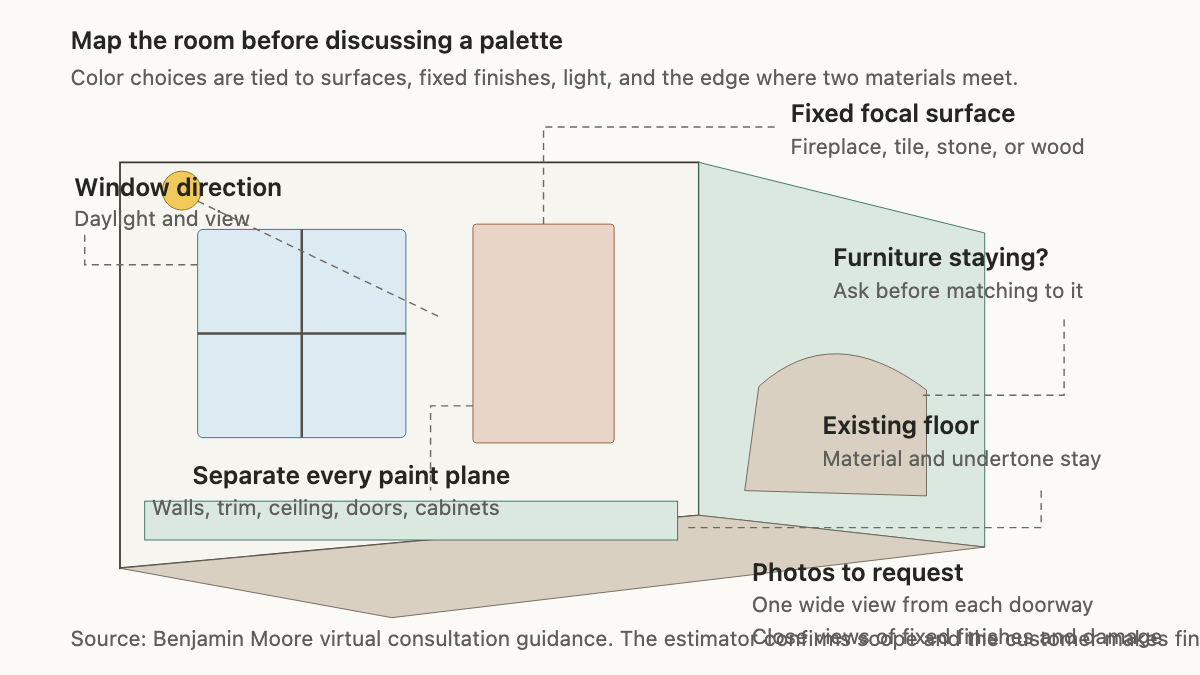
Also capture the direction and pattern of light in plain language. Ask which wall receives strong daylight, whether the room is much darker in the afternoon, and which lamps are normally used at night. Reception does not need to label the room’s exposure if the caller is unsure. “Bright window behind the sofa until noon” is a useful note.
If the customer has inspiration images, existing paint records, builder specifications, designer documents, or physical chips, request them through the company’s approved channel. Keep the source attached to the job. A screenshot of a color on social media is an inspiration reference, not a reliable paint specification.
Ask about the decision, not the caller’s favorite adjective
Words such as airy, cozy, clean, dramatic, warm, and neutral can start a conversation. They cannot finish one. Ask for a concrete example of what the customer likes and what they want to avoid. “I dislike the yellow cast in the current hallway” gives the consultant more to work with than “I want something timeless.”
A short call can collect these preferences:
- Which current surface or room color do you like enough to keep?
- Are there two or three candidate colors already under consideration?
- Which fixed material must the new paint coordinate with?
- Who must approve the final selection, and will that person attend?
- Is there a date when the color schedule must be final so ordering and the work plan can proceed?
Do not promise that a screen rendering or phone photo represents the finished color. Screens, camera processing, room light, surrounding colors, sheen, substrate, and application all affect what a person sees. The consultation can narrow choices. A physical sample review gives the customer a better approval point.
Make sampling part of the handoff
Small chips are useful for narrowing a group. They are poor substitutes for seeing a larger sample at the wall. Benjamin Moore’s paint-sampling guidance advises viewing chips upright, moving larger samples around the room, checking corners, and looking under different lighting conditions.
Turn that guidance into a simple office process. Record which candidate colors need samples, who obtains them, where the customer will view them, and when the approval is due. The selected product’s instructions control preparation and use. The office should avoid creating a universal sample-size or coat-count promise.
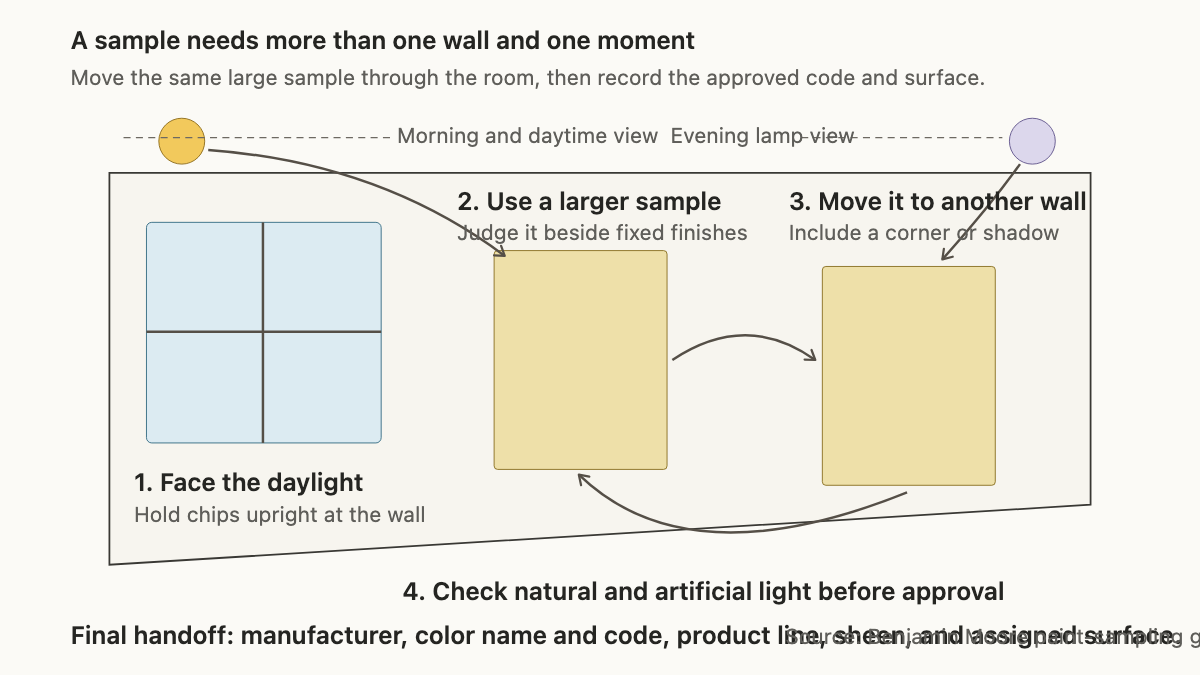
The final approval should identify more than a color nickname. Record the manufacturer, color name and code, product line, sheen, and assigned surface. “Soft white everywhere” is not a purchase record. A useful schedule reads more like this fictional example: “Living room walls: Sample Color A, code 123, interior wall product, eggshell. Trim and doors: Sample Color B, code 456, trim product, satin. Ceiling: existing specification confirmed by owner.” The estimator or project lead can replace those fictional labels with the approved products and real codes.
Ask the decision-maker to approve the schedule through the company’s normal written process. If two people share approval, name both. If a designer or property manager controls the selection, record that authority before ordering. Verbal comments scattered across calls and texts invite mistakes.
Flag scope and safety issues without solving them at reception
Color questions sometimes reveal a different project. Peeling paint, recurring stains, damaged drywall, water marks, chalking, rust, or failed caulk belong in the estimate record. The office should request photos and route the condition for review. It should not promise that primer or another coat will solve an unknown cause.
Construction date matters when work may disturb older painted surfaces. The EPA Renovation, Repair and Painting Program covers paid work that disturbs painted surfaces in covered pre-1978 housing and child-occupied facilities. EPA-administered and authorized state or Tribal programs may govern the details. Ask the property’s approximate year and use. Flag a possible covered project under company policy. Do not make a legal determination during color intake.
The lead-safe painting call-intake guide gives the front office a more detailed route for those calls. The interior and exterior painting intake guide covers surface scope and site access. General appointment ownership belongs in the painting estimate scheduling guide.
Send the estimator a color-status note
A useful handoff tells the estimator what has been decided, what remains open, and who owns the next step. Consider this fictional note:
“Interior repaint request for living room, entry, and connected hall. Customer wants color guidance before final estimate. Walls, ceilings, trim, two doors, and built-ins are in scope. Oak floor, red brick fireplace, cream sofa, and white kitchen cabinets will remain. Strong morning light at front windows; room looks darker after 2:00 p.m. Wide photos and fireplace close-up requested. Customer has three wall candidates and no trim selection. Both homeowners approve. In-home consultation requested. Estimator to confirm service scope, surfaces, condition, sampling plan, product and sheen options, color-schedule deadline, and whether the 1964 construction date requires lead-safe review before disturbance.”
That note gives the appointment a purpose. It avoids pretending the color is settled, and it keeps ordering behind a written approval step.
An AI receptionist can collect the same fields after hours when the contractor defines its consultation service, exclusions, and escalation rules. The most useful Monday handoff is specific: the customer has three wall candidates, the brick stays, both owners must approve, and the home dates to 1964.