A property manager calls about “five little touch-ups” before a tenant moves in Friday. One is a black scuff. Two are nail holes. Another is a brown ceiling stain. The last is a peeled patch beside a bathroom door. Those five spots do not belong in one blind price.
The office should collect wide and close photos, the exact surfaces, damage type, paint records, property age, access, deadline, and the caller's expectation for the finished appearance. Then state the company's minimum-visit policy in its approved wording. The estimator or painter decides whether the work is a spot treatment, a repaired patch, a full wall or trim run, or an inspection before any painting is quoted.
Find out what “touch-up” means on this call
Start with the location. Ask for the room and the precise surface: wall, ceiling, baseboard, door, cabinet, railing, siding, or another painted component. “Bedroom touch-up” could mean one clean wall scuff or a damaged corner that needs compound, sanding, primer, and paint.
Ask what happened. A rub mark, nail hole, gouge, peeling edge, recurring stain, water mark, cracked caulk, rust spot, and failed drywall tape suggest different work. Reception should record the caller's words and request photos. It should not diagnose the cause.
The Sherwin-Williams touch-up guide separates small imperfections from larger areas and mismatched finishes. It also calls for evaluating and preparing the damage before paint is applied. That distinction belongs in call intake because the caller may use “paint” to describe a repair job.
Ask how many locations are involved, but do not stop at a spot count. Record each room, each surface, and whether the marks sit together or across the property. Ten nail holes on one empty wall are a different mobilization and protection problem from ten marks scattered through an occupied three-story home.
Request two kinds of photos
A close photo shows the chip, hole, stain edge, texture, or peeling film. A wide photo shows the whole wall plane, nearby corners, doors, windows, furniture, floor protection needs, and access. Both matter.
Give the caller a simple photo request: “Please send one straight-on photo of the full wall or surface and one close photo of each damaged area. Include an everyday object for scale if the size is hard to judge.” A ruler works when the caller has one. Avoid asking someone to climb, lean over a stair rail, or enter an unsafe area for a better angle.
For tall foyers, stairwells, exterior elevations, or occupied commercial rooms, note access and working conditions. Ask about ceiling height only if the caller knows it. Capture stairs, locked areas, pets, furniture, customer traffic, and the hours when the surface is available.
Photos help route the estimate. They do not guarantee that color, sheen, texture, adhesion, or moisture can be judged accurately through a phone screen.
Capture the paint record without promising a match
Ask whether the caller has leftover paint. If so, collect a photo of the label and lid. Useful details include manufacturer, product line, color name or code, sheen, purchase date if shown, room assignment, and how the container was stored. Ask whether the original wall was brushed, rolled, or sprayed if the caller knows.
A color name alone is incomplete. The same named color in a different product or sheen can look different. Old paint in a can may also have changed, while the wall has been exposed to light, cleaning, abrasion, cooking residue, or ordinary aging.
Sherwin-Williams advises matching color, sheen, and texture for touch-up work. Its contractor application FAQ also says the original application method matters because a different method can create a visible sheen or texture difference. If a repaired area remains visible, the FAQ says the entire wall may need paint.
That is the expectation to set on the call. Say, “The photos and paint information will help us evaluate the request. The painter still needs to confirm whether a spot repair can blend or whether the cleanest scope is the full wall or surface.”
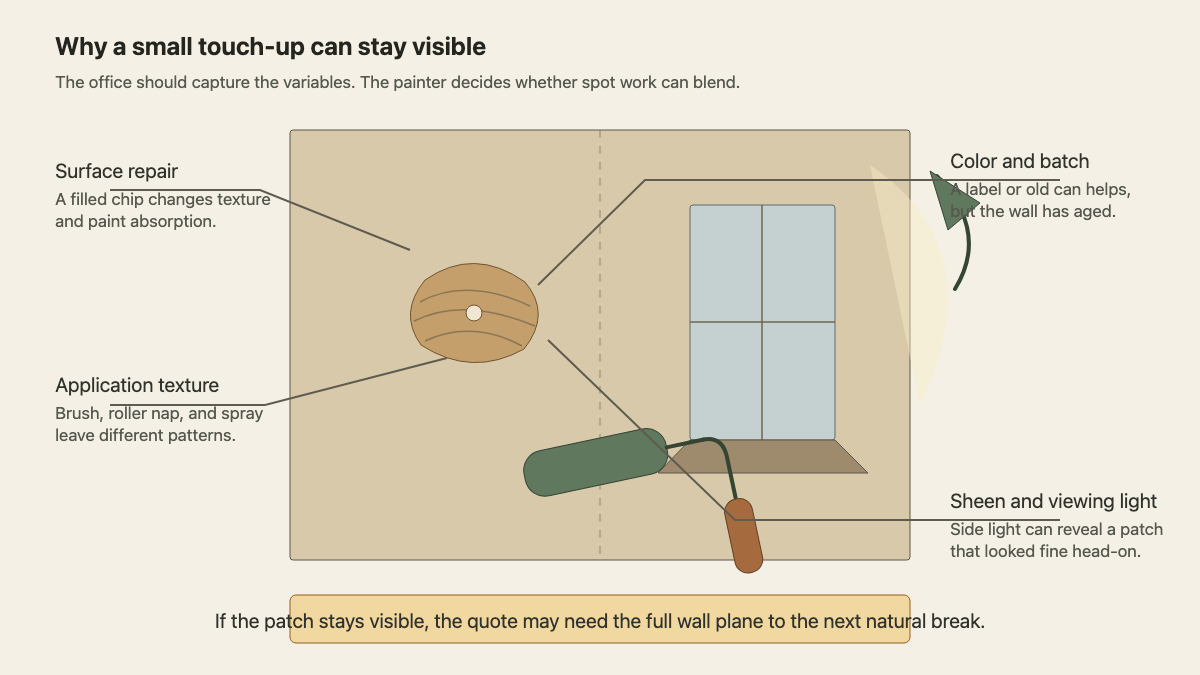
Define the natural break in the surface
When spot work cannot blend, the next scope is often a complete visual plane. On an interior wall, that may run corner to corner and baseboard to ceiling. On trim, it may be one full casing, door face, or continuous baseboard run. Cabinets, exterior siding, railings, and textured ceilings need their own estimator judgment.
Reception should identify those boundaries without deciding the quote. Ask whether the damage sits on one wall or continues around a corner. For trim, ask which component is affected. For a door, clarify the face, edge, frame, and surrounding casing. This gives the estimator a realistic alternate scope to review.
Keep drywall repair separate. A gouge, popped fastener, failed tape joint, or hole may need a repair trade and a finish specification before paint can be priced. The drywall repair call-intake guide covers size, texture, substrate, and ready-to-paint versus finished-paint expectations.
Explain the minimum visit as a service policy
Small jobs still require scheduling, travel, setup, floor and furniture protection, material handling, cleanup, and a qualified worker's time. A company may therefore use a minimum service charge, a half-day minimum, a small-project package, or an estimate-first policy. Reception should use the exact approved policy and never invent a discount or price to save the call.
A useful explanation names what the minimum includes. For example: “Our small-project minimum covers the scheduled visit and the work listed in the approved scope. Matching, repairs, materials, high access, and expansion to a full wall are confirmed before work proceeds.” Replace that fictional wording with the company's real terms.
Then ask whether the caller has other eligible painting items at the same property. This is a scope question, not an upsell script. The customer may have a second damaged wall, a trim run, or a closet that fits the same visit. Keep unrelated repairs out of the painting work order.
If the caller only wants a rough price, explain what evidence is still missing. A number based on “three small spots” hides the variables that control the visit. The broader painting estimate scheduling guide can help offices decide when photos are enough and when an on-site estimate is the responsible route.
Screen for conditions that need escalation
A stain that is damp, growing, or returning needs cause review before cosmetic paint is promised. Peeling around a window, soft drywall, powdery material, active leakage, mold-like growth, or a strong odor also deserves escalation under company policy. Ask whether the source has been repaired and who confirmed it. Record the answer without turning it into a warranty.
Property age and use matter when the proposed work could disturb painted surfaces. The EPA Renovation, Repair and Painting Program applies to paid work that disturbs paint in covered pre-1978 housing and child-occupied facilities. EPA-authorized state and Tribal programs may administer their own requirements. Ask for the approximate construction year, property use, and work description, then route the record through the company's lead-safe process. Reception should not declare a project exempt.
The lead-safe painting intake guide gives a fuller workflow for older homes and child-occupied facilities.
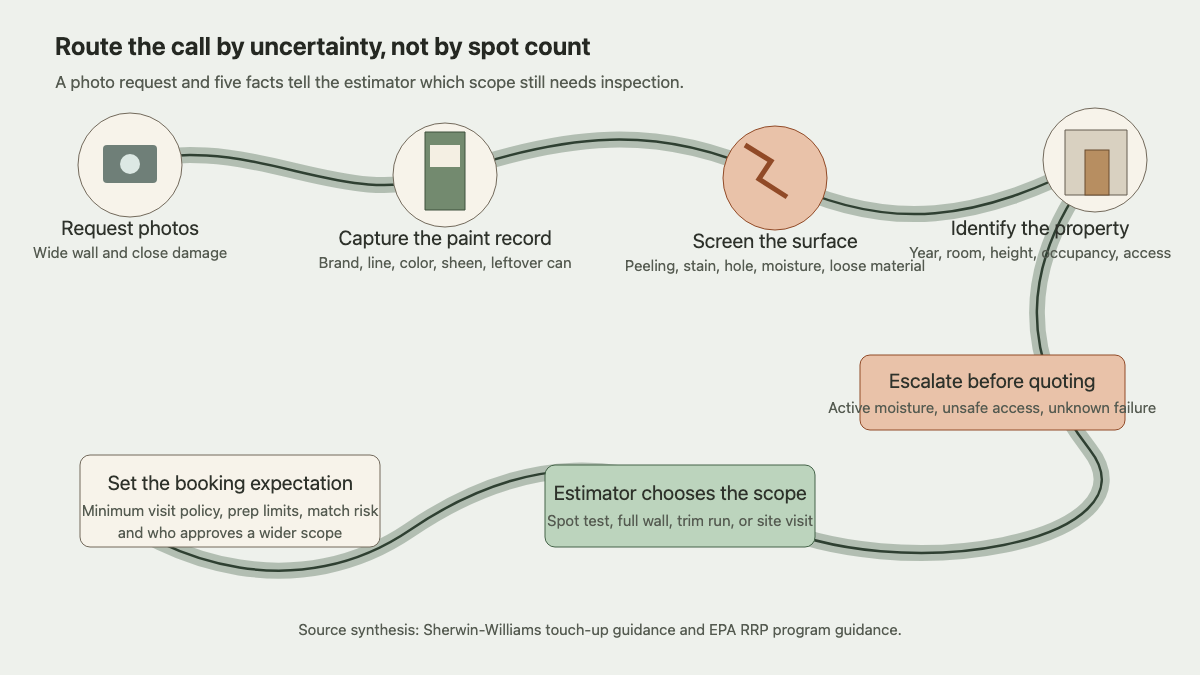
Send a bounded handoff to the estimator
The handoff should separate observed facts, customer expectations, open questions, and the company's stated policy. A fictional record might read:
“Occupied rental turnover due Friday. Living room has two nail holes and one scuff on the same eggshell wall. Hall ceiling has an old brown stain; caller says the roof repair was completed but has no dry-out document. Bathroom door casing is peeling near the floor. Wide and close photos received. Leftover wall paint label shows product, color code, and eggshell sheen; no matching trim paint found. Building reportedly dates to 1969. Second-floor unit with elevator access. Customer expects marks to disappear and asked for a spot price. Office explained the small-project minimum in approved terms and made no match promise. Estimator to confirm dry-surface evidence, lead-safe routing, repair scope, spot-test feasibility, and any full-plane alternate.”
An AI receptionist can collect the same fields after hours if the contractor defines its minimum policy, photo channel, exclusions, and escalation rules. The useful result is a clean work record: two likely wall spots, one unresolved ceiling stain, one peeling casing, a 1969 property, and a customer who needs the match risk explained before Friday.