A property manager calls at 4:40 on Friday. She wants a price to repaint an occupied medical office and says the crew can work “after hours.” That phrase sounds useful until the estimator learns that patients leave at 6:00, cleaning starts at 6:15, the alarm arms at 9:30, one exam room runs late on Thursdays, and the building engineer must inspect each finished zone before it reopens.
The office should capture six things before scheduling the estimate: the spaces in scope, hours of actual activity, rooms that may close, routes that must remain open, access and building rules, and the people who approve the work. A room count is still useful. It simply cannot carry the schedule by itself.
Start with the business, then count the walls
Ask what happens in the building on a normal day. A retail store has customer traffic, stocking, deliveries, cash-office access, and opening procedures. A warehouse has dock periods, forklifts, shift changes, charging areas, and production lanes. An office may look quiet after 5:00 but still have a cleaning crew, late meetings, server rooms, or employees working across time zones.
Record the posted hours and the real hours. “Open 9:00 to 5:00” may mean the first employee arrives at 7:15 and the last leaves at 7:00. Ask for the earliest entry, final departure, delivery windows, cleaning schedule, alarm cutoff, and any day that behaves differently.
Then define the surfaces. Separate walls, ceilings, doors, frames, trim, handrails, masonry, exposed structure, and specialty areas in the note. The Sherwin-Williams surface preparation guidance is organized by substrate because gypsum board, concrete, wood, and metal do not share one preparation method. Reception does not need to prescribe that method. It does need to tell the estimator what is present and where damage has been reported.
Useful condition details include peeling, stains, impact damage, patched areas, recurring moisture, rust, failed caulk, and an unknown existing coating. Ask for wide photos of each zone and closer photos of representative damage through the company’s approved channel. A close-up of one scuff cannot establish the size of a corridor or the height above a stairwell.
Draw the phase map during the call
Commercial painting guides commonly discuss work after hours, on weekends, during low-traffic periods, or in phases. CertaPro’s commercial scheduling guide describes phases by room, floor, department, access point, or building. Those categories are a good start for intake, but the estimator still needs a physical map of the operation.
Ask the caller to name areas in plain language: front reception, west corridor, conference suite, loading hall, second-floor offices. For each area, record whether it can close, when it can close, who uses it, and which neighboring area must stay available. A corridor may be part of the paint scope and the only route to an occupied department. That conflict belongs in the estimate record.
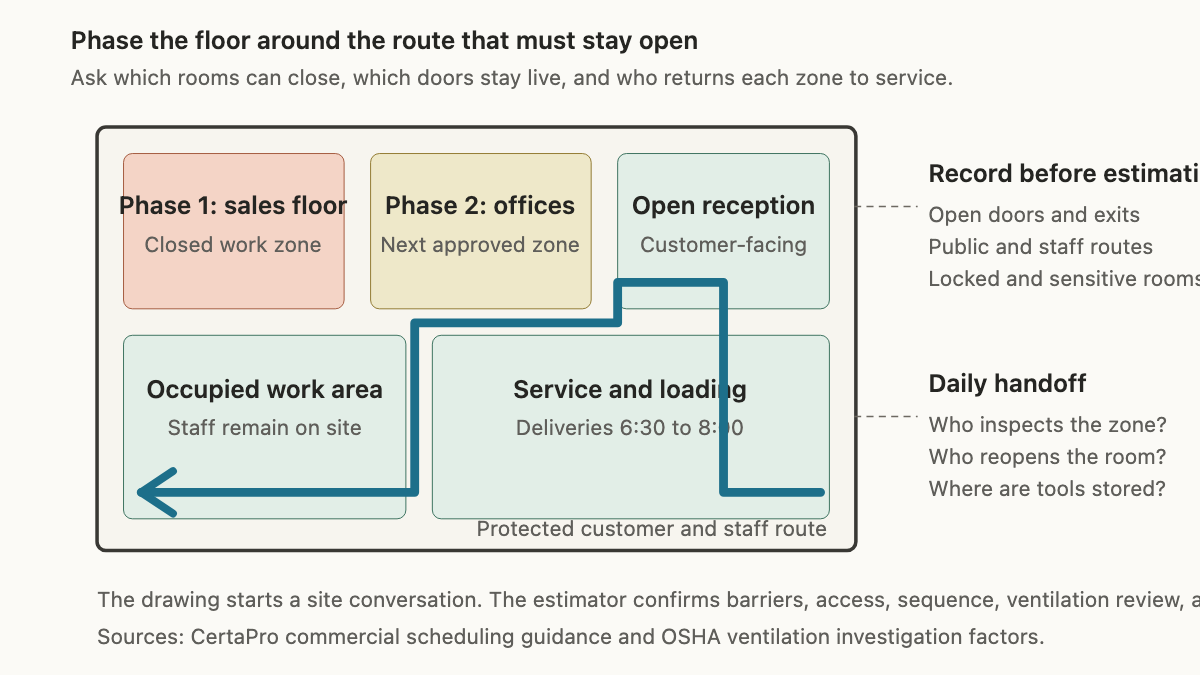
The map also needs entrances, loading access, elevators, stairs, locked rooms, sensitive areas, and the route for customers or staff. If the caller has a floor plan, request it. If not, a marked photo or rough sketch can help the estimator prepare for the walk-through.
Do not let the first call turn a rough sequence into a promise. “Sales floor first, offices second” is a request for review. The project team still has to assess protection, access equipment, ventilation, surface preparation, materials, staffing, and the selected coating system.
Put fixed events on the operating clock
“Night work” is too vague for a commercial painting schedule. Put times next to every fixed event the caller knows. One sample record might read: customers leave by 6:00 p.m.; cleaners occupy the east wing from 6:15 to 7:45; deliveries use the rear hall from 6:30 to 8:00 a.m.; alarm access ends at 10:00 p.m.; facilities staff can inspect a completed zone at 6:45 a.m.
Ask these questions in order:
- What are the public hours, staff hours, shift changes, delivery periods, cleaning times, and quiet periods?
- Which rooms must remain available every day, and which can close for a full shift or weekend?
- Who opens the building, controls keys or badges, changes the alarm schedule, and signs the crew out?
- Are there tenant notices, loading reservations, elevator bookings, insurance documents, parking rules, or security escorts to arrange?
- Who reviews a finished zone, and what must happen before staff or customers return?
The last question prevents a common handoff gap. A crew may finish its planned work, but someone still owns inspection, cleanup review, furniture reset, access restoration, and the decision to return the area to service.
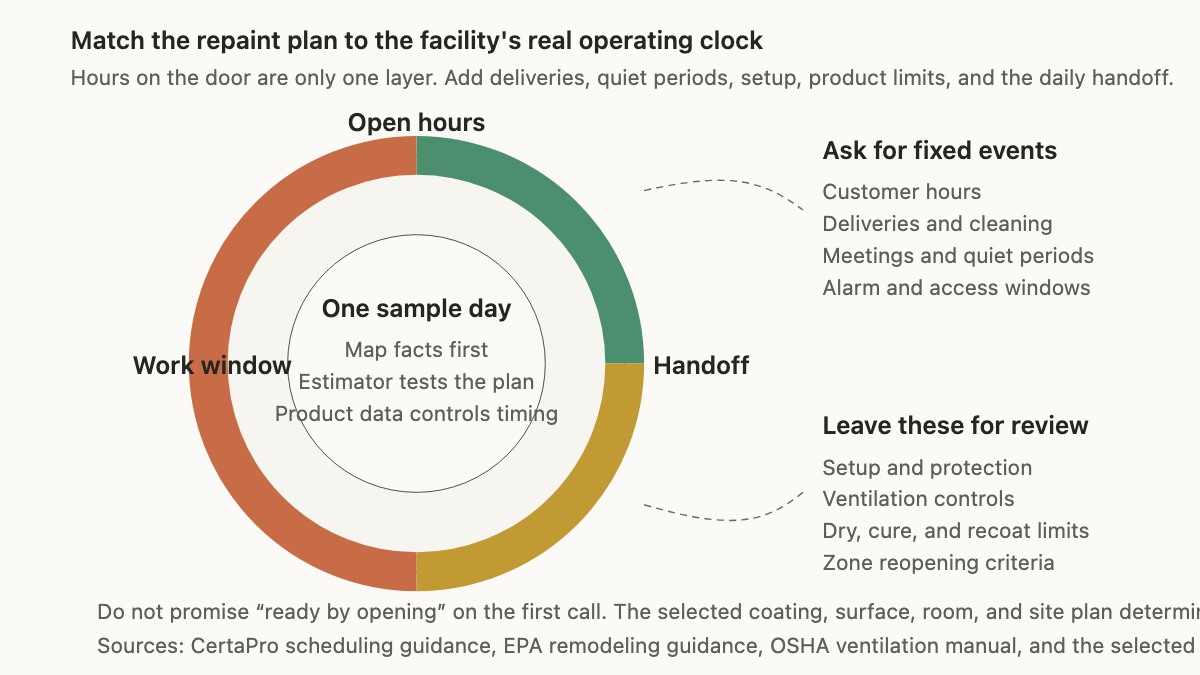
Never promise “ready by opening” before the product, surface, room conditions, preparation, application plan, and site controls have been reviewed. Dry-to-touch, recoat, cure, ventilation, odor, and occupancy are different questions. The selected product data and the project plan govern them.
Keep safety and air decisions with qualified staff
Reception can collect facts about occupants, HVAC, windows, doors, adjacent rooms, sensitive operations, and complaints. It should not design ventilation controls or tell a caller that opening a window makes the area safe.
The OSHA Technical Manual chapter on ventilation asks investigators to consider emission sources, timing, air movement, supply and return conditions, HVAC influence, and worker location. That is far beyond a booking script. The office’s job is to preserve the site facts so a qualified person can evaluate them.
Ask whether the facility includes healthcare treatment, food preparation, child care, laboratories, manufacturing, server rooms, animals, or occupants who have raised sensitivity concerns. Record the caller’s description without offering a health conclusion. Route it under the contractor’s policy.
Product claims need the same restraint. “Low odor” is not an occupancy decision. EPA guidance on indoor environmental concerns during remodeling directs readers to use products for their intended setting, follow label precautions, and consider ventilation and occupants. The estimator or project lead needs the proposed product, its current data, and the actual facility conditions before setting the work and reopening plan.
Older buildings may add another review. If painted surfaces could be disturbed in pre-1978 housing or a child-occupied facility, flag the construction date and building use. The lead-safe painting intake guide explains how to capture that information without making a compliance promise.
Identify the people who can approve each part
Commercial repaint calls often involve more than one decision-maker. The person requesting a quote may be a tenant, assistant manager, maintenance coordinator, broker, or regional employee. Capture the property owner or authorized client, site contact, facilities contact, security contact, and invoice contact when they differ.
Ask who approves scope and color, who can authorize changes, and who controls the schedule. For multi-tenant work, note whether the caller expects one proposal, separate phases, or separate approvals. Do not promise that a landlord, tenant, insurer, or building manager will accept a scope.
The general painting estimate scheduling guide covers appointment ownership and follow-up. The interior and exterior intake guide helps classify surfaces and access. Commercial work adds the operating map: who occupies each zone, when the business uses it, and who returns it to service.
Give the estimator a note that can survive the site walk
A good note is short enough to scan and specific enough to test. Here is a fictional example:
“Occupied two-floor dental office, 8:00 a.m. to 6:00 p.m. Monday through Thursday and 8:00 a.m. to 2:00 p.m. Friday. Scope request covers reception, two corridors, 11 treatment rooms, doors and frames. Reception and one corridor must remain available. Cleaning runs 6:15 to 8:00 p.m. Deliveries use rear corridor 6:30 to 7:30 a.m. Facilities contact controls alarm and can meet estimator Tuesday at 7:00 a.m. Existing wall coating unknown. Reported scuffs, patched gypsum board, and stained ceiling tile near treatment room 4. Photos and floor plan requested. Caller wants a weekend phase plan. Estimator to review surfaces, protection, access, products, ventilation, sequence, and reopening criteria.”
That note gives the estimator a place, an operating pattern, a preliminary scope, known conflicts, access ownership, visible condition, missing evidence, and the customer’s requested schedule. It makes no promise about price, safety, cure, or reopening.
An AI receptionist can collect the same fields after hours if the contractor defines the questions, exclusions, and escalation rules. The handoff should still sound like the note above. Monday’s estimator needs to know that the rear corridor becomes a delivery lane at 6:30 a.m., not merely that the customer prefers weekend work.