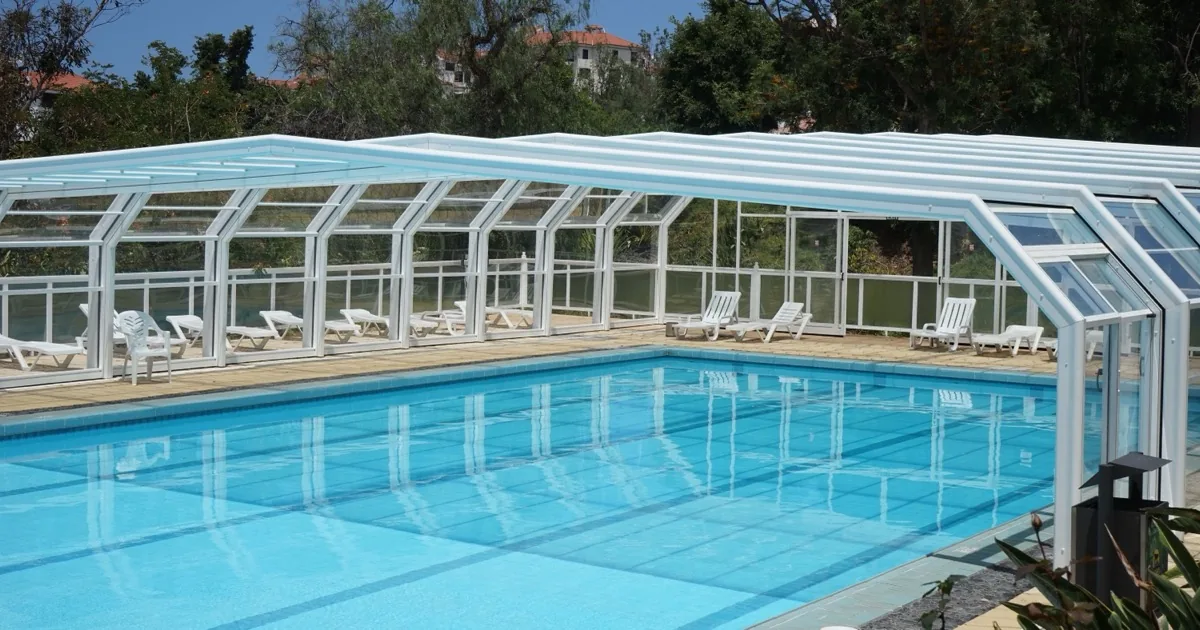
A homeowner calls with one fact: “My pool is 18 by 36. How much for a safety cover?” The office could treat those two dimensions as a quote. Then the installer arrives and finds a raised spa, a narrow paver deck, fixed handrails, a rock waterfall, and anchors left from a cover whose serial label has disappeared.
The right first step is a measurement visit.
For a pool safety cover installation quote, confirm the caller means a safety cover, learn whether this is a new installation or replacement, document the pool and deck conditions, request useful photos, and book an on-site measurement. The office can explain the process and collect the evidence. Final fit, anchoring, product selection, and compliance claims belong with the installer, the manufacturer’s instructions, and any local requirements.
Confirm what the caller means by “pool cover”
“Pool cover” can describe several products with different jobs. A caller may be asking about a leaf cover, winter cover, solar blanket, automatic cover, or a tensioned safety cover secured around the pool. Start with purpose and operation before discussing brands.
Ask what the owner wants the cover to do, how they expect to open and close it, and when it will be used. If they say “safety cover,” ask whether they are looking for a product represented as meeting ASTM F1346. Do not turn that question into a blanket promise about whatever is on the truck.
ASTM F1346-23 covers safety covers for pools, spas, hot tubs, and wading pools. Its public scope says the specification includes performance tests and marking requirements. It also ties the intended risk reduction to correct installation and use under the manufacturer’s instructions. That last point matters on the phone. A familiar product name or a pool’s rough dimensions do not establish that a finished installation will meet the standard.
Record whether the caller needs a manual cover or is asking about a powered system. Note whether the pool is in-ground, above-ground, or paired with a spa. If the requested product falls outside your company’s work, route that answer quickly. A clean “we install tensioned covers on in-ground pools, but we do not install automatic track systems” saves a pointless site visit.
If the caller is actually looking for recurring cleaning and chemical care, move them into the weekly pool maintenance signup intake. That request needs a service-frequency and equipment record, not a cover-measurement appointment.
Separate a new installation from a replacement
A replacement call may already contain valuable records. Ask whether the old cover is available and whether the owner can find a manufacturer name, serial number, sewn label, invoice, warranty document, or installer record. Request clear photos of the full cover, its labels, springs, straps, anchors, worn areas, and the pool with the cover removed.
Do not assume the existing anchors are reusable. The installer needs to inspect their locations, condition, surrounding deck, and compatibility with the proposed cover. A new fabric panel can look like a simple swap while the old system hides bent hardware, loose anchors, changed decking, or a remodel that altered the pool edge.
Ask what changed since the previous cover was made. A new patio, resurfaced coping, added handrail, removed diving board, rebuilt waterfall, expanded spa, or replaced deck section can change the field conditions. So can an old cover that never fit correctly. Capture the owner’s complaint in plain language: “gap near raised wall,” “strap no longer reaches corner anchor,” or “water collects near steps.” Those observations give the installer a place to inspect without pretending the office diagnosed the cause.
For new installations, find out whether the pool is complete and whether the surrounding deck is finished. If construction is still underway, record the project stage and the builder’s contact. The installer can decide when measurements are reliable.
Build a site record before booking the visit
The best intake feels less like a product quiz and more like a map of the property. Start with the service address, pool location, gate access, parking, pets, locked areas, and the person who can approve the work. Then move toward the water.
Capture these details:
- Pool type, approximate length and width, overall shape, and whether plans or prior measurements exist
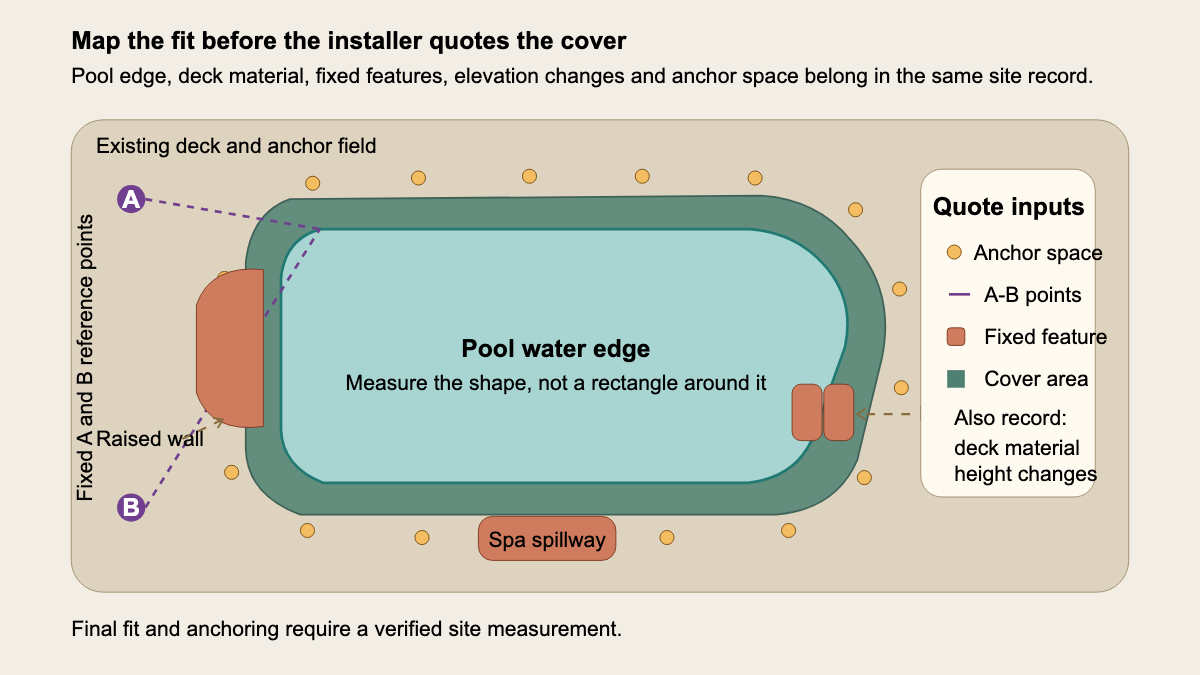
- Attached spa, steps, benches, sun shelf, negative edge, waterfall, rock feature, or raised wall
- Fixed ladders, handrails, grab rails, slide legs, diving stand, fill spout, or other hardware near the water edge
- Deck material and condition, including concrete, pavers, stone, wood, grass, planters, repaired sections, narrow areas, and changes in elevation
- Existing cover, anchors, springs, straps, storage bag, labels, serial number, visible tears, missing hardware, and fit complaints
- Recent or planned work to the coping, deck, rails, spa, water feature, or pool shell
- Safe access for measuring, drilling, power, equipment movement, and future cover storage
- Desired timing, who will attend the visit, and who makes the purchase decision
Photos help, but ask for the right ones. Request one view from each end, wide corner views that include the surrounding deck, and close views of fixed features or damage. The homeowner should stay on stable ground. They do not need to lean over the pool, climb onto a wall, remove hardware, or take underwater measurements for an office estimate.
A manufacturer’s custom pool-cover measuring instructions show why a few phone dimensions are incomplete. The guide calls for a sketch of the water edge, deck and nearby obstructions, reference measurements from fixed A and B points, cross dimensions, photos, and closer documentation around rails, slides, rocks, spas, waterfalls, planters, raised areas, and changing deck levels. Those are manufacturer-specific instructions, so another system may use a different process. The broader lesson is solid: the pool shape and the surrounding installation surface form one job.
Keep safety language accurate
A safety-cover inquiry often comes from a parent, grandparent, pet owner, or property manager who is worried about access to the water. Take that concern seriously without promising that one product makes the pool childproof.
The U.S. Consumer Product Safety Commission’s residential pool barrier guidance presents covers as one layer of protection. It also states that barriers cannot replace adult supervision and tells owners to check local building codes and regulations. The office should preserve that framing.
Avoid claims such as “this cover is all you need,” “your fence no longer matters,” or “the installation automatically passes code.” Product documentation may support a specific standards claim. Local authorities determine local requirements. Gates, fencing, door alarms, pool alarms, supervision, and operating practices remain separate questions.
The same restraint applies to damaged covers. If the caller reports a tear, loose anchor, broken spring, large gap, standing water, or a cover pulled into the pool, tell them not to rely on office staff to certify it as safe from a description. Record the condition, request photos from a safe position, preserve other access controls, and route the issue under the company’s inspection policy.
Set the quote visit up to succeed
Before offering a time, check who needs to be present and what must be accessible. The installer may need the old cover removed or available for inspection, labels and paperwork gathered, gates unlocked, pets secured, and the full deck clear enough to measure. Company policy and the chosen manufacturer should determine preparation instructions.
If the visit includes drilling or installation rather than measurement alone, say so clearly. A quote appointment, field measurement, anchor inspection, repair assessment, and installation day are different commitments. Name the appointment type in the calendar so the customer and technician expect the same work.
This also matters during pool closing and winterization booking. Closing staff may discover missing hardware or a damaged cover, but a custom replacement can require its own measurement and lead time. Keep that work separate unless your operating procedure combines it deliberately.
Ask whether any pump or filter repair is also pending. Cover work and equipment work may share an address, yet they need different notes, parts, and technician skills. A second service need should appear as a linked job, not a surprise added at the gate.
Send the installer a site-ready ticket
A useful handoff sounds like this:
“Replacement safety-cover inquiry for an in-ground kidney-shaped pool with attached raised spa. Existing mesh cover and hardware are on site; customer found the manufacturer label but no serial number. Photos show two fixed handrails, a stone waterfall, paver deck on three sides, and a narrow planting strip along the back edge. Deck was repaired near the spa last year. Caller reports a gap near the raised wall and one strap that does not reach. Measurement visit booked for Tuesday at 10:00 a.m. Homeowner will provide gate access, secure two dogs, and have the old cover available. Installer to verify pool geometry, existing anchors, deck condition, product options, and any preparation needed before a final quote.”
That note gives the field team a real starting point. “Customer wants cover price” does not.
An office receptionist or AI receptionist can collect the same approved fields after hours and flag replacement damage or unusual site features. It should stop before choosing hardware, certifying the deck, or promising standards compliance. Those decisions depend on the actual pool in front of the installer.
Read back the appointment type, access plan, photos requested, old-cover records, fixed features, recent deck changes, and who will be present. When the installer opens the ticket, the backyard should already be more than two dimensions and a guess.