A homeowner calls at 7:10 on a Monday morning. Her faucets are dry, the well sits behind her neighbor's barn, and she does not know whether the neighbor has water. She wants a truck now. Before dispatch can build a useful ticket, the office needs to identify the affected properties, the equipment location, the person who can provide access, and the person who may approve the work.
That is the core of shared well service intake. Record the physical system and the people attached to it. Ask for the written agreement, but leave legal interpretation to the owners and their advisers. A well contractor can diagnose equipment and document findings. Reception should not decide who owns a pump, whether an easement permits entry, or which neighbor must pay.
Start by finding the edges of the problem
The first question is simple: “Which properties have the same problem right now?”
Ask the caller to contact the other connected household if that can be done safely and without delaying an emergency response. Record each answer separately. “Neighbor thinks theirs is fine” is weaker than “John at 18 Pine Road opened the kitchen cold tap at 7:16 and had normal flow.” If nobody can reach the other property, say so on the ticket.
When every connected home has no water, the shared side of the system deserves early attention: electrical supply, controls, pump, pressure equipment, common main, or the well itself. A problem at one home may be downstream of the shared equipment, such as a closed valve, frozen section, leak, treatment device, or branch line. This is triage, not a remote diagnosis. The technician still has to test the system.
The same distinction helps with low pressure. Ask whether the change appears at every fixture, whether hot and cold behave alike, and what happens when a second fixture opens. Our guide to whole-house versus one-fixture low water pressure gives the office a fuller symptom sequence. On a shared well, repeat the scope question for each property.
For a complete outage, capture immediate needs too. Livestock water, a medically vulnerable resident, an occupied rental, or a business that cannot operate may affect dispatch priority under the contractor's policy. Do not promise an arrival time the schedule cannot support. Follow the company's existing no-water emergency call process.
Draw the system in plain language
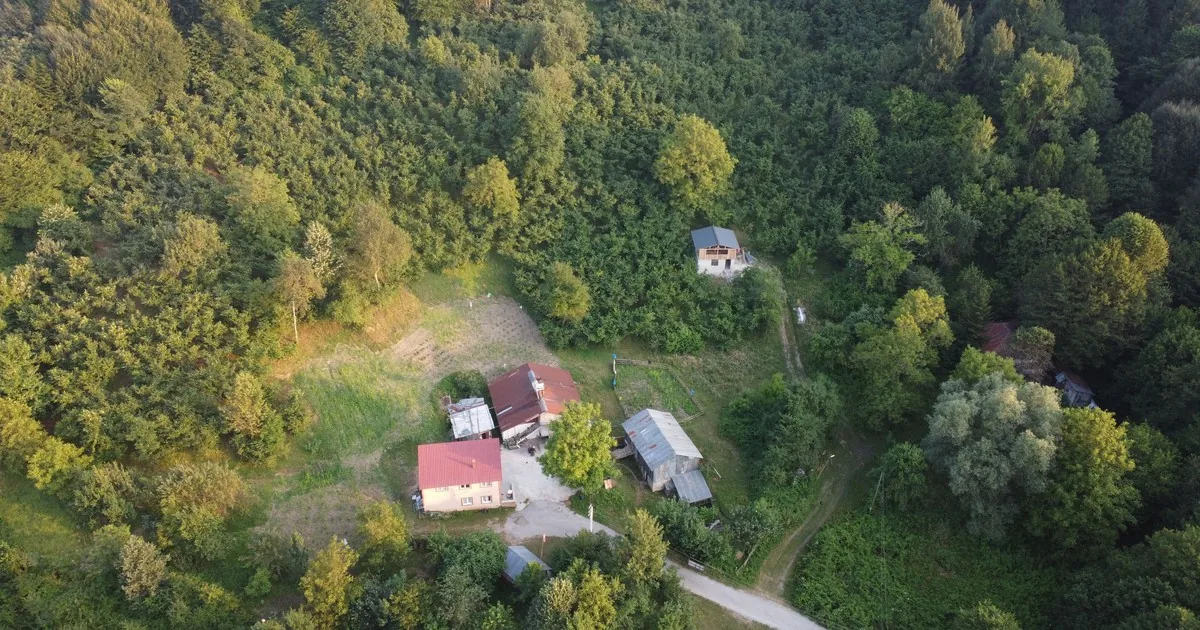
A shared well is easier to service when the ticket says where each component sits. Start with the street addresses and parcel names used by the owners. Then ask:
- Which property contains the wellhead, well house, pit, or buried access point?
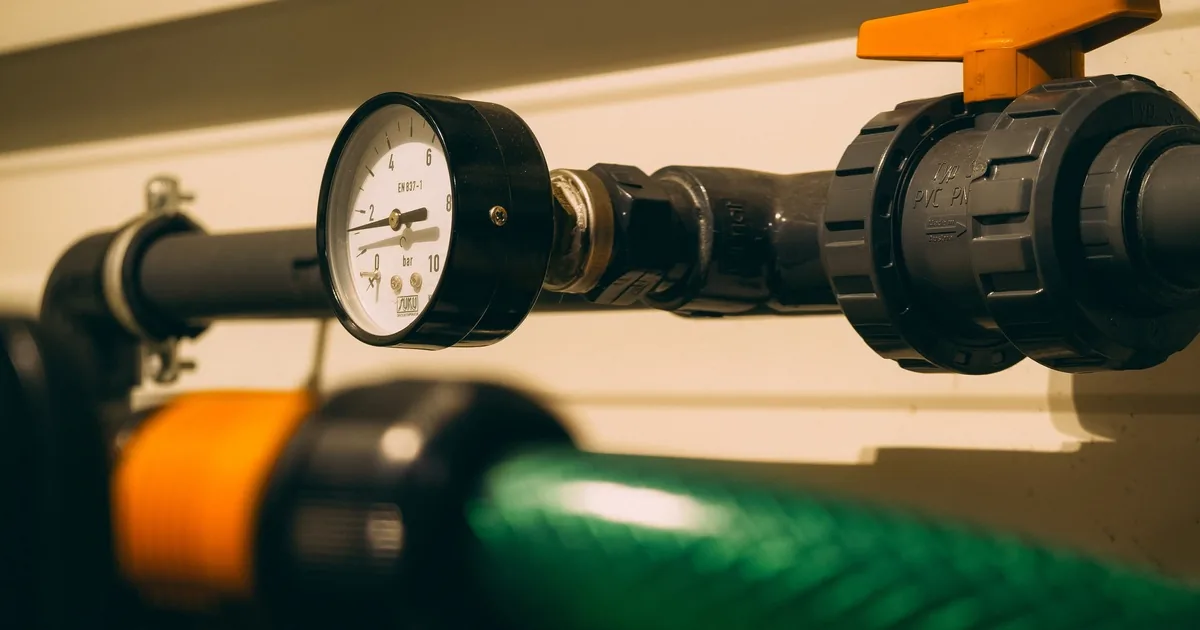
- Where are the pressure tank, control box, disconnect, meter, treatment equipment, and branch shutoffs?
- Which property supplies electricity to the pump?
- Where does the common line divide into individual branches?
- Can a service truck reach the equipment, and are gates, animals, snow, crops, or locked buildings in the route?
- Does the caller have a well log, system sketch, prior invoice, pump record, or recorded agreement?
Do not ask a caller to open a well cap, enter a pit, touch wet electrical equipment, or remove control covers. Photos taken from a safe position can still help. Request a wide view of the equipment area, label plates that are already visible, the access route, and any obvious leak or damaged pipe.
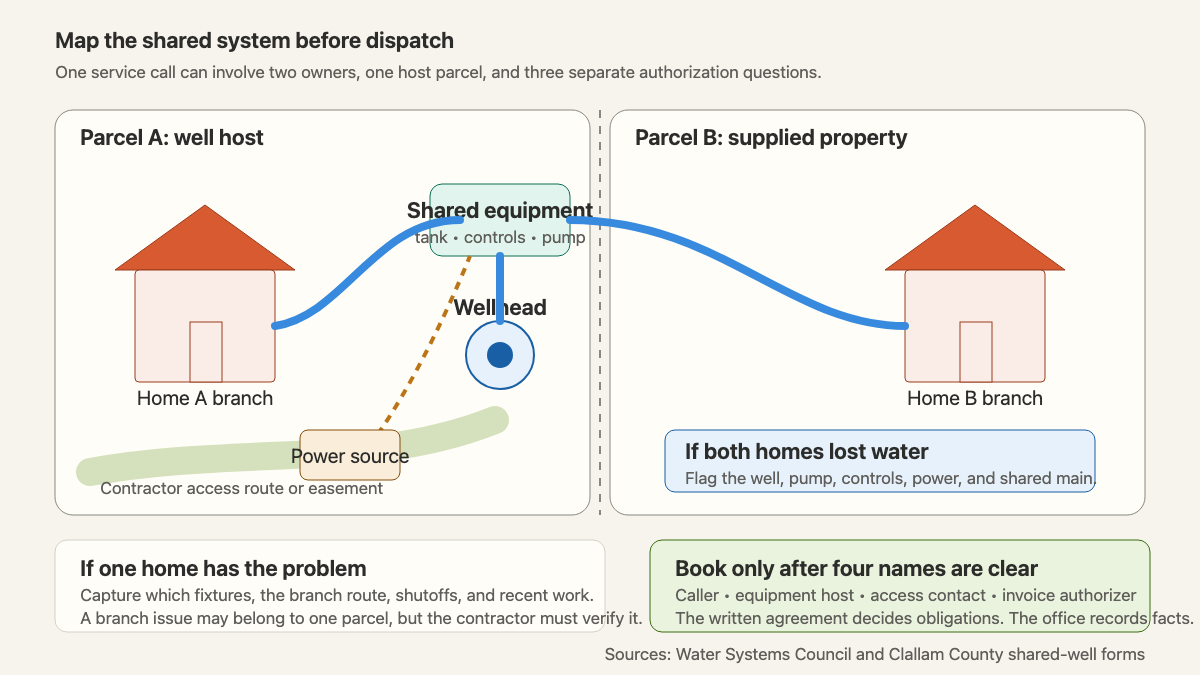
The Water Systems Council sample shared-well agreement identifies the supplying parcel, supplied parcel, well, distribution system, maintenance duties, expenses, and access easements. A Clallam County shared-well form uses a similar split between common system work and pipes serving individual dwellings. Those forms are useful intake references because they show why “the neighbor's well” is not enough detail. They are samples, not a ruling on any caller's agreement.
Record four roles, even when one person fills all of them
Shared-well calls become messy when the office writes one customer name at the top and assumes that person controls the property, the equipment, and the money. Use separate fields for four roles:
- Caller: the person reporting the symptom and the property where it was observed.
- Equipment host: the owner or occupant of the parcel where the well and common equipment are located.
- Access contact: the person who can open a gate, secure animals, admit the technician, or coordinate entry.
- Work and invoice authorizer: the person who can approve the diagnostic visit, receive findings, authorize added work, and accept the company's billing terms.
Sometimes one neighbor fills all four roles. Sometimes the caller is a tenant, the well sits on a second owner's land, a property manager controls access, and a third person handles invoices for an owners' association. Write each name, phone number, address, and role. Note who has been contacted and who has confirmed.
Arthur Macomber's shared-well agreement drafting guide explains why specificity matters: the parties, properties, well, distribution system, maintenance liabilities, and easements all need clear identification. The service desk can apply that lesson without giving legal advice. Specific names and locations produce a cleaner dispatch.
Keep access, permission, and billing separate
A key may open the gate. It does not automatically authorize a pump replacement. A person who approves diagnosis may not agree to pay every repair. And the owner receiving the invoice may expect another household to reimburse part of it under a private agreement.
Ask who approves the initial service charge under the contractor's terms. Define what that charge covers. If diagnosis reveals additional work, stop at the company's normal approval threshold and contact the named authorizer. Where several owners want separate estimates or invoices, record that request before work begins and confirm what the contractor's billing system can support.
Do not promise a cost split. The Water Systems Council sample discusses proportionate common expenses, individual service pipes, advance consent for some expenditures, and an emergency exception. The Clallam County form contains its own provisions. The actual recorded agreement may say something different, and local law may affect the result. Reception can request a copy and attach it to the job. An owner or attorney must interpret it.
Use equally careful language around access. Say, “We need the equipment host or access contact to confirm entry before arrival.” Avoid saying, “The easement lets us go in,” unless the contractor has an established policy and qualified advice for that exact situation. If owners disagree while water is out, dispatch management should decide whether the job can proceed, what written authorization is needed, and whether legal guidance is required.
Build a dispatch note the technician can use
A good ticket can be read once in the driveway. Put the operational facts near the top:
Symptom and scope: No water at 14 Pine Road since 6:50 a.m. Normal water confirmed at 18 Pine Road at 7:16 a.m. No visible flooding or burning odor reported.
System location: Wellhead and control box behind the detached barn at 18 Pine Road. Pressure tank in the barn's north utility room. Pump power comes from the 18 Pine Road panel. Caller is unsure where the branches divide.
Access: Gate code confirmed by the host. Two dogs will be secured. Gravel lane is passable for the service truck. Host will meet the technician at 9:30.
Contacts and authority: Caller at 14 Pine Road approves the diagnostic visit under the company's stated terms. Host at 18 Pine Road approves access. Both owners want findings before repair work beyond diagnosis. Email the service report to both.
Records: Shared-well agreement and prior pump invoice attached. No well log available. Photos show the equipment room and visible labels.
That note does not assign fault. It gives the technician a starting map, reduces arrival surprises, and preserves what each person actually approved.
Handle disputes without turning dispatch into a courtroom
A caller may insist that the neighbor always pays. Another may say the branch belongs to the first house. A tenant may claim the landlord has ignored the issue for days. Record those statements as statements: “Caller says the 2022 pump bill was split equally.” Do not convert them into facts such as “repair costs are shared 50/50.”
The industry overview from Water Conditioning & Purification International lists usage, maintenance, electricity, disputes, and termination among the subjects an agreement may cover, while warning that local requirements differ. That variability is exactly why the service office should stay in its lane.
If disagreement blocks access or authorization, escalate inside the company. Send the owners the factual scope, the contractor's service terms, and the smallest decision needed to proceed. Keep photos, timestamps, approvals, technician findings, and signed changes with the job. Those records help the company explain what it did. They do not settle the neighbors' contract.
Give every shared-well call a named next step
Before ending the call, repeat the appointment window, access plan, diagnostic authorization, contact sequence, and water status at each property. Name the missing item if booking remains provisional: host confirmation, a gate code, the recorded agreement, or approval from another owner.
A shared system can fail in one place and create confusion across several households. The office adds real value by making the service boundary visible before the truck moves. On the final ticket, “neighbor” should have become a name, an address, a role, and a confirmed way into the equipment room.