A buyer’s agent calls at 3:40 on Friday. The inspection period ends next Wednesday, the house has a private well, and the agent asks for “a flow test.” That phrase could mean a timed check at a faucet, a documented well-yield test, a broad well inspection, or water-quality sampling. Those are different appointments.
Start with the report recipient. Ask who requested the work, what test method that party accepts, which observations must be recorded, whether it has a required form, and when the report is due. Only then should the office choose a slot.
A defensible booking also captures the well record, pump setup, access, discharge route, water-use restrictions, present symptoms, and property contact. The technician can confirm the field conditions. Reception should never predict the well’s gallons per minute or promise that a report will satisfy a lender, buyer, county, or health department without seeing that party’s requirements.
Name the service before discussing the calendar
“Well test” is too broad for dispatch. A water-quality sample looks for contaminants. A pressure service call investigates delivery pressure in the plumbing system. A general inspection may examine the casing, cap, pressure equipment, treatment equipment, records, and visible defects. A yield test asks how much water the well can produce on a sustained basis.
New York’s water-well standard defines yield as a sustainable quantity of water per unit of time, usually expressed in gallons per minute. Its standard test records both flow and the water level in the well during drawdown and recovery. Penn State Extension describes the same physical question: how much water can be pumped on a sustained basis as the aquifer moves water toward the well.
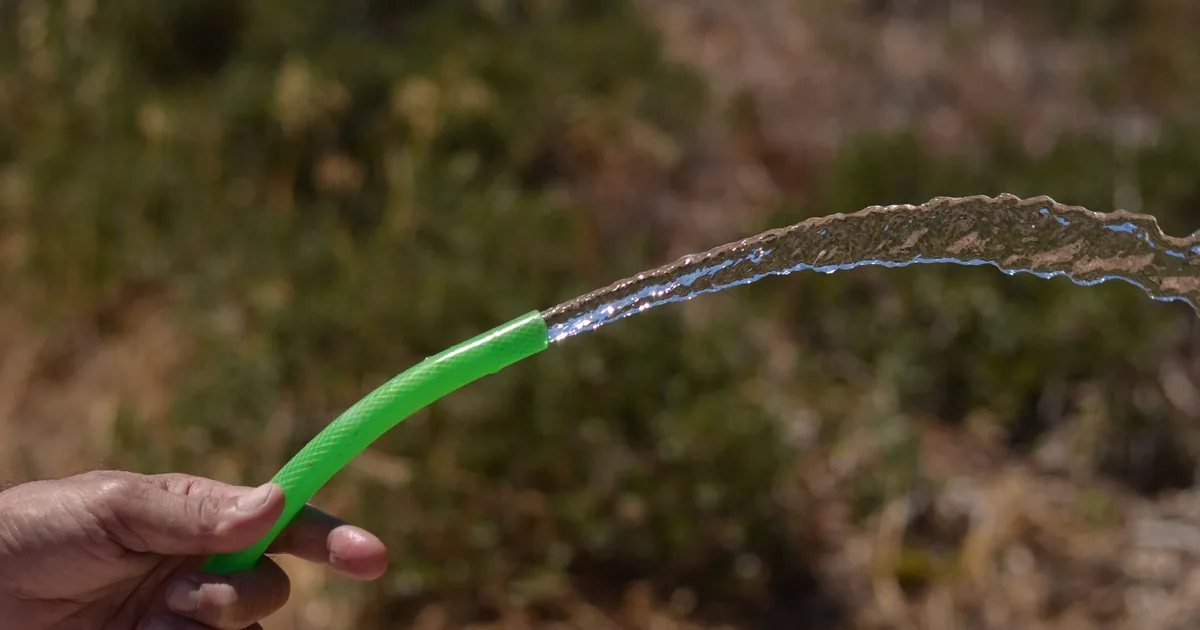
That is different from filling a bucket at a hose bib. A brief outlet check reflects the pump, pressure tank, piping, restrictions, fixture, and conditions at that moment. It does not, by itself, document the well’s long-term production.
Ask the caller to read the request aloud or email it. Useful words include “yield,” “production,” “drawdown,” “recovery,” “constant rate,” “flow test,” and “quantity evaluation.” Record the wording exactly. Do not translate “four-hour stabilized drawdown” into “run water for four hours” and assume the scope is settled. The contractor needs the full protocol.
Start with the person who will accept the report
Test requirements can come from a buyer, lender, home inspector, engineer, regulator, driller, or property owner. Their purposes differ. A new-well completion record, a home-purchase contingency, and an investigation of seasonal water loss should not be booked from the same one-line service description.
The New York standard is a good example of why the recipient matters. It calls for a defined period of stabilized drawdown in its standard method, water-level tolerances, periodic observations, and recovery monitoring. It also permits modified or alternate testing in specified circumstances. That is one jurisdiction’s framework, not a nationwide appointment template.
Minnesota’s property-transfer guidance illustrates another source of confusion. The state treats disclosure, water-quality testing, physical inspection, and evaluation of water quantity as separate matters. It also notes that describing a well as “in use” does not guarantee its quality or yield. A lender or county may add requirements that the state does not impose.
Before quoting time or deliverables, capture:
- the requesting party and a direct contact for questions;
- the exact protocol, form, or written scope;
- the property address and parcel or well identifier, if provided;
- the deadline, inspection-contingency date, and closing date;
- the required contractor qualification, signatures, photos, and report format;
- whether water quality, inspection, or another service is also requested.
If the caller has no written requirement, say what your company’s standard service includes and excludes. Do not imply that your normal test will be accepted by an unseen third party.
Collect records before the truck rolls
A well log or completion report may contain the well depth, casing details, construction date, original yield, pump setting, and contractor. Prior test reports show what method was used and when. Repair invoices may reveal a replacement pump, changed controls, a deepened well, or hydrofracturing. Ask for the documents before the visit when possible.
Minnesota recommends that property buyers obtain well construction, testing, repair, and maintenance records. For dispatch, even an incomplete record helps. Label every detail by source: “owner reports 280-foot well” is better than entering “well depth: 280 ft” as though someone verified it.
Ask where the wellhead is and whether it is visible above grade. Record locked gates, steep or soft access, livestock, dogs, snow, brush, and vehicle restrictions. If the well is in a pit or confined space, nobody at reception should coach the caller to enter it. The contractor decides whether safe access and specialized equipment are required.
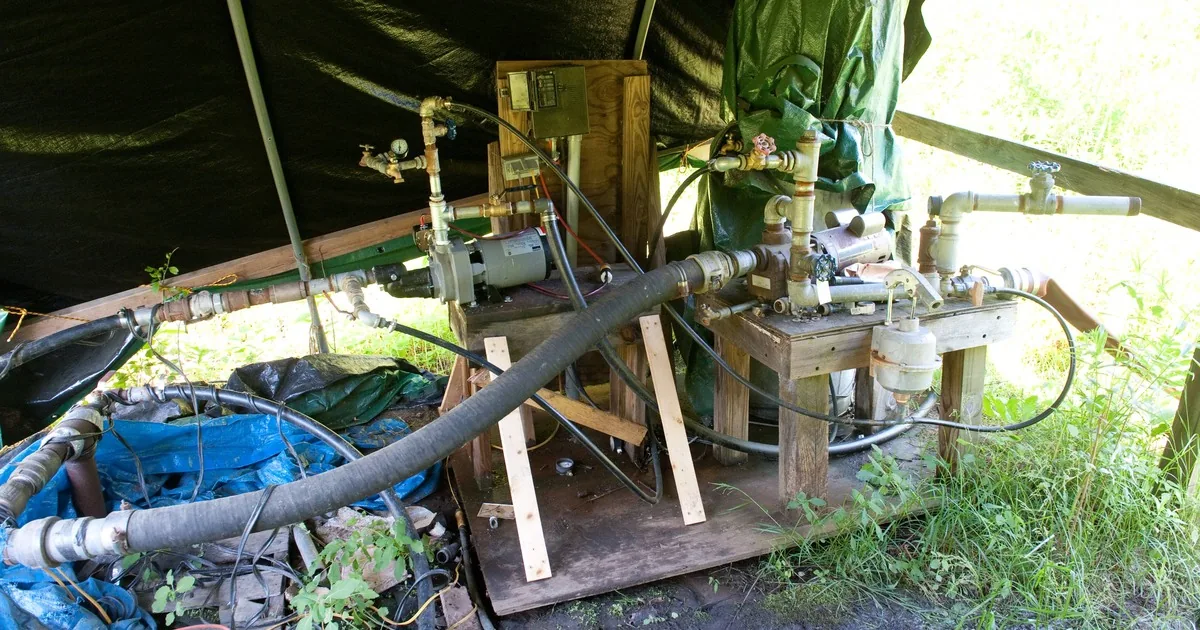
Equipment details belong on the ticket too. Ask whether the pump is submersible or above ground, whether the property has a pressure tank or intermediate storage, and whether treatment equipment can affect the discharge route. Capture the pump make, model, horsepower, and installation date only if the caller has a record or can read an accessible label without opening equipment.
Protect the test window from ordinary water use
A yield test depends on controlled conditions. A washing machine starting mid-test, an irrigation zone opening, or a tenant taking a shower can change the demand the technician sees. Ask who occupies the property, what water-using equipment is connected, and whether normal use can be paused for the required period.
Do not invent the restriction. The contractor should state when water use must stop and when it may resume under the chosen method. Reception’s job is to identify conflicts early: occupied rentals, livestock waterers, irrigation timers, treatment backwash cycles, shared wells, fire-protection connections, and a seller who cannot be present.
The discharge location deserves its own line on the work order. New York requires test water to be discharged so it does not short-circuit back into the aquifer. Penn State likewise describes routing pumped water away from the well during a constant-rate test. Ask about nearby septic components, ditches, ponds, slopes, neighboring land, erosion-sensitive areas, and any local discharge restrictions. The technician chooses the setup on site.
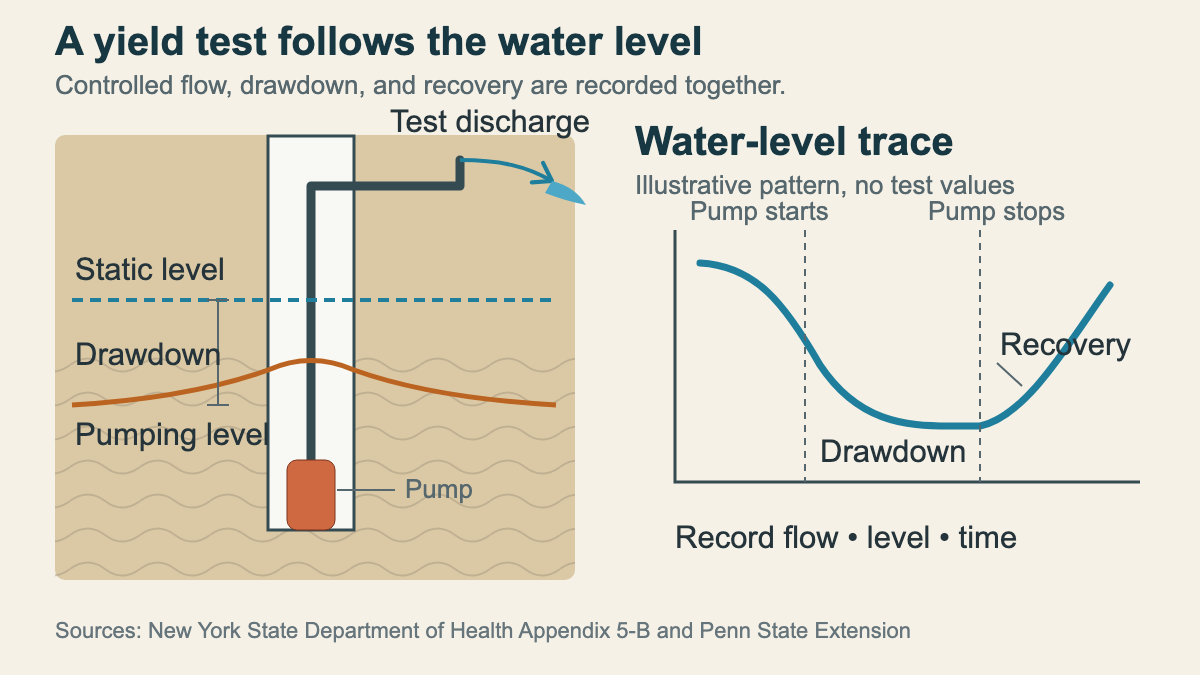
The visual shows why a proper appointment may occupy a long field window even when water appears quickly at the hose. Flow is only one observation. Water level and recovery supply the context needed to judge whether that flow is sustainable under the required method.
Separate symptom calls from transaction tests
Some callers use “yield test” because the house has begun running short of water. Ask what changed and when. Useful observations include loss of water during simultaneous use, air at fixtures, sediment, pressure that does not recover, a pump that runs continuously, and a problem that appears only during dry weather.
Safety changes the route. Burning odor, smoke, sparking, exposed wiring, repeated breaker trips, a hot control box, a flooded equipment area, or an unsecured well opening should be escalated under the company’s safety procedure. Do not tell the caller to reset controls repeatedly, remove a cap, reach into a pit, or keep pumping a well that may be running dry.
A symptom visit can still lead to a production test, but the contractor may need to inspect the pump and controls first. Keep the original complaint in the ticket. “Buyer needs quantity report by Tuesday” and “home loses water after ten minutes of irrigation” are separate facts, and both matter.
For pressure complaints confined to one faucet or shower, use the whole-house versus one-fixture pressure intake. For a transaction that needs a wider review of the well and equipment, see the well inspection scheduling guide. Those routes prevent an expensive quantity test from becoming the default answer to every water complaint.
Write a field-ready handoff
A good dispatch note lets the technician see the purpose, protocol, property, and constraints without replaying the call. Write it in that order.
“Buyer’s lender requested a documented quantity test” is useful. Add the lender’s attached protocol, report due date, well record, owner-reported pump information, occupancy, water-use conflicts, wellhead access, discharge concerns, current symptoms, and site contact. Mark unknowns plainly.
Confirm what the appointment includes before ending the call. State whether the booking covers yield testing only or also includes inspection, water-quality sampling, or diagnosis. Explain when the customer should expect the report and who receives it, using the company’s actual process.
An AI receptionist can capture these fields after hours and route the request for review, but the script must preserve uncertainty. “Protocol attached for contractor review” is an honest handoff. “Your well will pass” is not.
The strongest final question is simple: “Before we schedule, can you send the exact requirement from the person who will accept the report?” That document can save a wasted site visit and several tense phone calls on the morning a contingency expires.