The first hard freeze arrives, and a caller says, “My front-door lock is frozen.” That description can hide several different jobs. The key may stop inside an iced cylinder. The deadbolt may turn with the door open but bind against the strike when the door is closed. The lock may work while the weather seal holds the door to the frame. Or a stiff, worn key may already be bending.
A useful door lock freezes in winter service call starts with one question: what moves, and what does not? Record how far the key inserts, whether it turns, whether the door opens, what the caller has already tried, and whether there is another safe entrance. Those details let the office route the call without pretending to diagnose the hardware over the phone.
Start with the part that will not move
Do not accept “frozen” as the final symptom. Ask the caller to describe the last normal action and the first failed one.
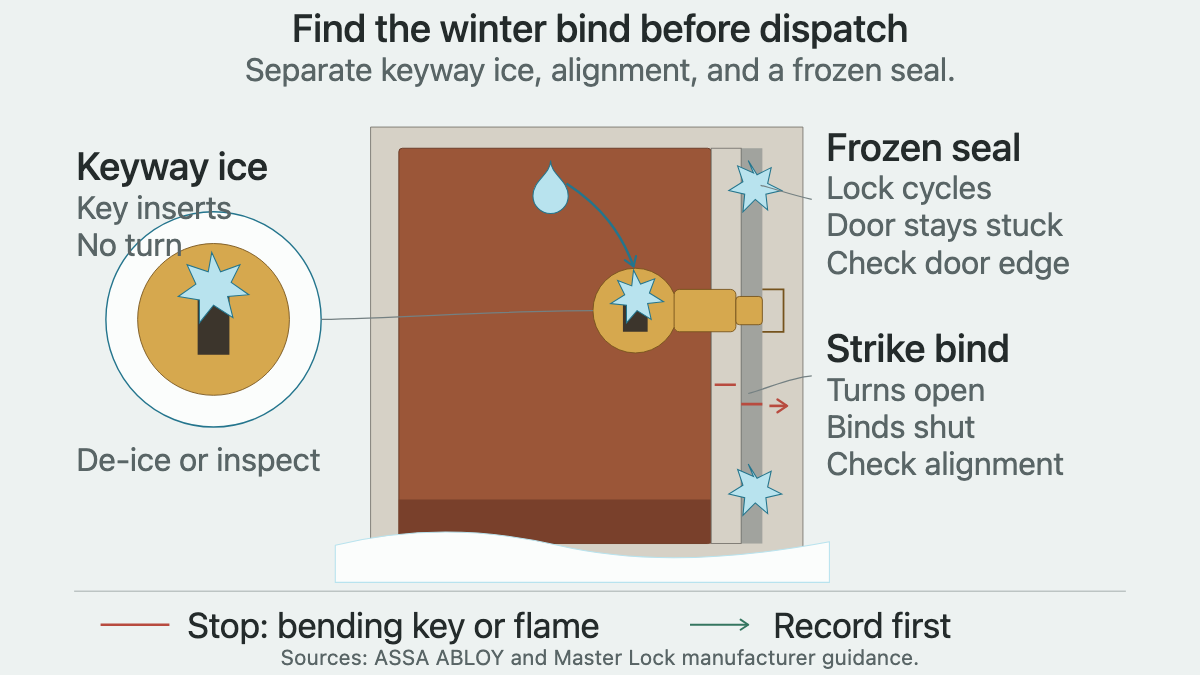
Can the key enter the keyway completely? Does it stop partway? Can it rotate at all? Does the key rotate but the bolt stay put? If the inside thumbturn is accessible, does it move normally? Does the lever or knob retract the latch? Can the door be pushed, pulled, or lifted slightly without asking the caller to force anything?
The answers separate several routes. A key that enters but will not rotate after wet snow and a temperature drop points toward a cylinder or keyway problem. A deadbolt that moves freely while the door is open but binds when it is closed points toward the relationship between the door, bolt, strike, and frame. A lock that cycles while the door itself stays stuck may involve ice at the threshold or weather seal.
Electronic hardware needs its own description. Ask whether the keypad lights, whether the lock beeps, whether the motor starts, and whether a mechanical backup key is available. Keep that call connected to the shop’s smart-lock battery failure intake if the main symptom is power or motor behavior.
Set a safety boundary before troubleshooting
The office should stop two actions immediately: forcing a key that is flexing and applying an open flame near the lock or door. Master Lock’s winter guidance recommends gentle warming or a lock de-icer for its covered products and warns against excessive force and open flames.
Ask whether the caller is outside, inside, or able to use another entrance. Note the weather exposure. A person standing in dangerous cold, a child locked inside, a running appliance, or a blocked required exit changes the urgency. Follow the company’s emergency policy and involve local emergency services when there is an immediate life-safety issue. Reception should not ask anyone to climb through a window, stand on ice, or dismantle security hardware.
If the key is beginning to bend, stop the turning attempts. A broken fragment changes the service scope and may block the keyway. If a piece has already snapped, move the call into the broken-key intake and record whether any part remains visible.
Water creates another boundary. Ask if the caller poured warm or hot water onto the hardware. Record it without scolding. Added water can reach the cylinder, latch, door edge, or threshold and may freeze again. The technician needs to know what happened and when.
Capture the opening and hardware
“Front door” is still too broad for dispatch. Identify the service address, which opening is affected, and what lies on each side. A house entry, detached garage, apartment common door, storefront, gate, shed, roof rack, and vehicle door may use different hardware and may fall under different shop capabilities.
Ask for the opening material and lock type in ordinary words. Is it a keyed knob, keyed lever, deadbolt, mortise lock, rim lock, padlock, smart lock, or multipoint door? If the caller can read a brand or model without removing anything, record it. Do not turn a visual guess into a confirmed model.
A few focused photos help more than a close-up that shows only the keyway. Under the shop’s approved photo process, request the whole door from inside and outside, the lock face, the door edge and bolt, the strike area, and visible ice or water. A short video can show whether the lock turns with the door open, but only if the caller can make that recording safely and the opening is already accessible.
For commercial doors, ask whether the affected opening is used by customers, staff, deliveries, or emergency egress. Record the closing device, panic hardware, card reader, or electric strike if one is present. A frozen cylinder on a secondary keyed entrance is a different dispatch problem from a door that will not latch or release on an occupied storefront.
Ask what has already gone into the lock
Product history matters. Ask for the name on any de-icer, lubricant, cleaner, penetrating oil, alcohol product, or other liquid applied to the keyway. Record approximately how much was used, when it was applied, and what changed afterward. A photo of the container label is better than “lock spray.”
Avoid giving one universal lubricant instruction. Lock makers publish different maintenance directions for different products. ASSA ABLOY’s cleaner and de-icer instructions, for example, specify how its own spray is applied, how long to wait before turning the key, and when to repeat lubrication. Master Lock’s padlock care guidance names a PTFE product for the cited padlocks and warns against other materials for that product line.
Those pages are useful because they show why reception should identify the hardware before recommending a chemical. A treatment approved for one cylinder or padlock should not be assumed correct for every residential, commercial, automotive, or electromechanical lock. When the shop provides phone guidance, it should come from the manufacturer’s instructions or a documented company procedure for that exact hardware category.
Heat needs the same precision. “I warmed it up” could mean holding the key in a gloved hand, using a hair dryer from a safe position, pouring water on the door, or applying a lighter to the key. Capture the method. If the caller mentions flame, overheating, smoke, melted trim, a burning smell, or damaged wiring, stop the experiment and route the added hazard under company policy.
Separate a frozen cylinder from door alignment
Winter changes more than the keyway. Moisture at a seal can freeze the door to the frame. Snow or ice at the threshold can resist movement. Wood movement, loose hinges, frame changes, or ordinary sag can put the bolt against the strike. The caller may experience all of these as “the lock will not open.”
When the door is already open and it is safe to test, ask whether the bolt and latch move freely without meeting the frame. If they do, record what happens as the door closes. Does the deadbolt need the door pulled inward, pushed outward, or lifted? Does the latch hit above or below the strike? Does the door rub at the top corner? Do not ask the caller to slam the door or grind the bolt through resistance.
A bolt that binds only against the closed frame belongs near the deadbolt will not latch intake. Preserve the winter context because ice, snow, and moisture may still matter, but do not send the technician a ticket that says “frozen cylinder” when the keyway turns normally.
If the lock cycles but the door perimeter is stuck, note where the caller sees ice. Include the threshold, bottom sweep, latch edge, hinge edge, and exterior weather seal. Also ask whether the door opens inward or outward. The locksmith may handle the hardware while a door, frame, or weatherproofing issue needs a different service path.
Build the dispatch record around observable facts
A winter lock ticket should make the technician’s first minute onsite less mysterious. Capture:
- the exact opening, lock type, known brand or model, and whether the property is occupied;
- how far the key inserts, how far it rotates, and whether it bends, grinds, or remains stuck;
- whether the latch or bolt moves with the door open and what changes when the door closes;
- visible ice, water, snow, corrosion, damage, door drag, or a frozen perimeter seal;
- every product, liquid, and heat method already tried, including the time and result;
- alternate access, spare keys, mechanical backup options, and the caller’s authority to approve work;
- photos or video received, current weather exposure, urgency, and the exact promise made.
Keep unknowns visible. “Caller cannot access the inside thumbturn” is useful. “Internal mechanism frozen” is a diagnosis the office has not established.
The next step may be controlled de-icing under a documented procedure, locksmith inspection, broken-key extraction, lockout service, door alignment work, electronic-lock troubleshooting, or a return visit for maintenance after the immediate access problem is resolved. State the boundary before dispatch. The technician may need to inspect the hardware before confirming whether it can be thawed, serviced, or replaced.
Read the critical facts back at the end: “Side entry at a single-family home. Key inserts fully but will not rotate. No fragment is broken. Caller used one spray of a product labeled lock de-icer ten minutes ago and no flame or water. The door was working yesterday, there is visible frost on the exterior cylinder, and the caller has safe access through the garage.” That ticket gives the locksmith a real symptom history while leaving the lock’s internal condition open for inspection.