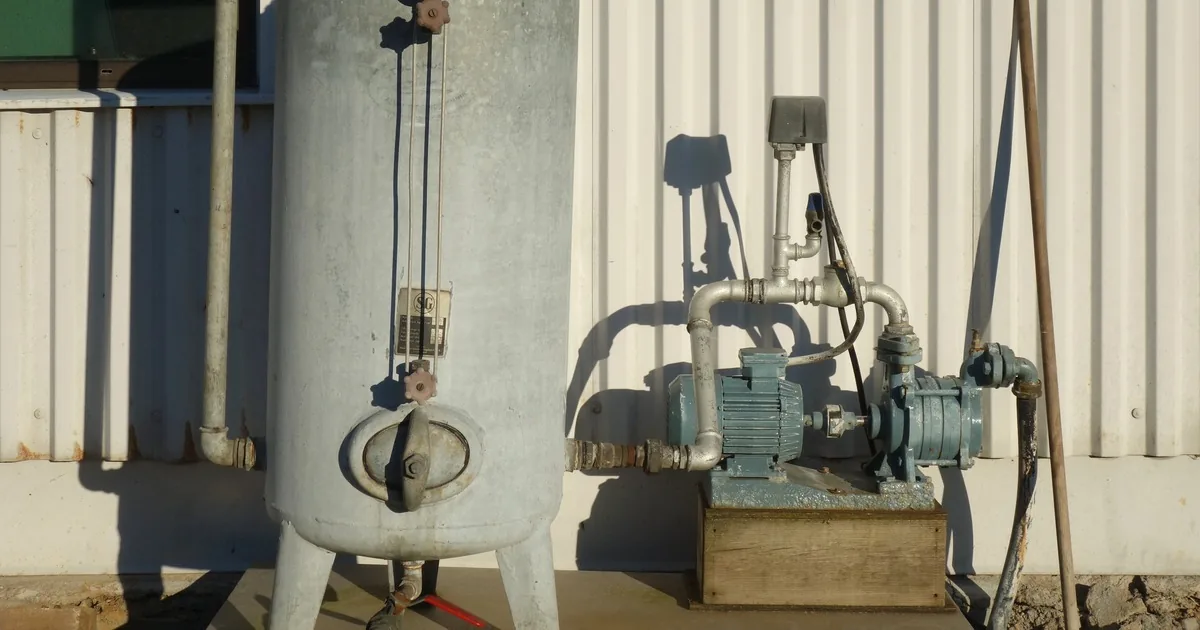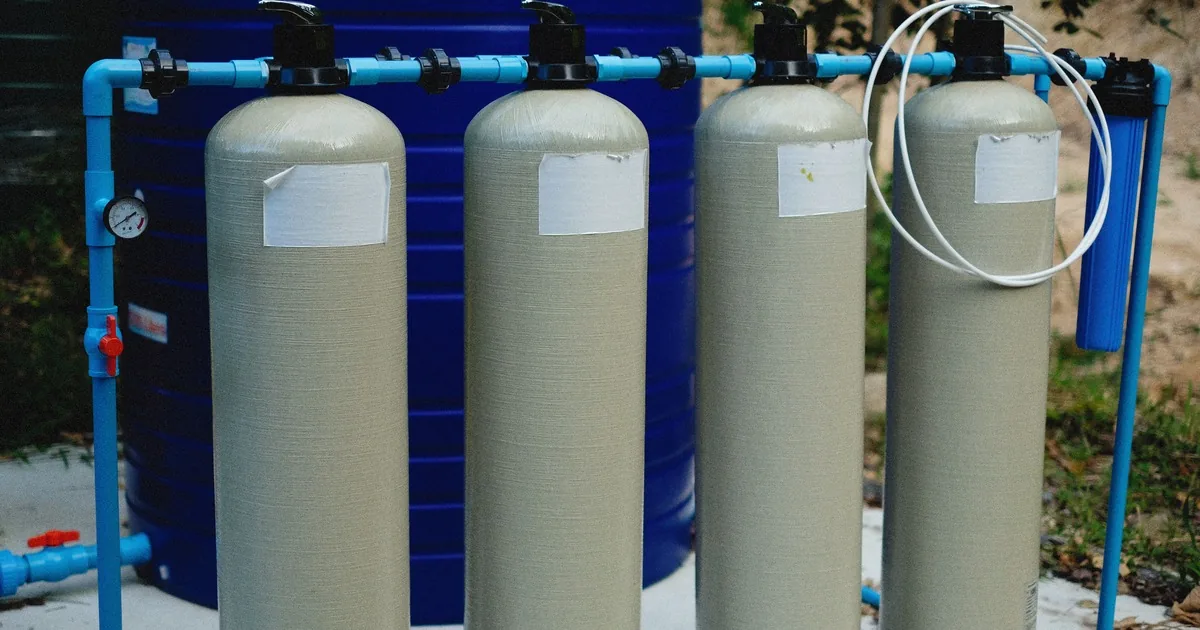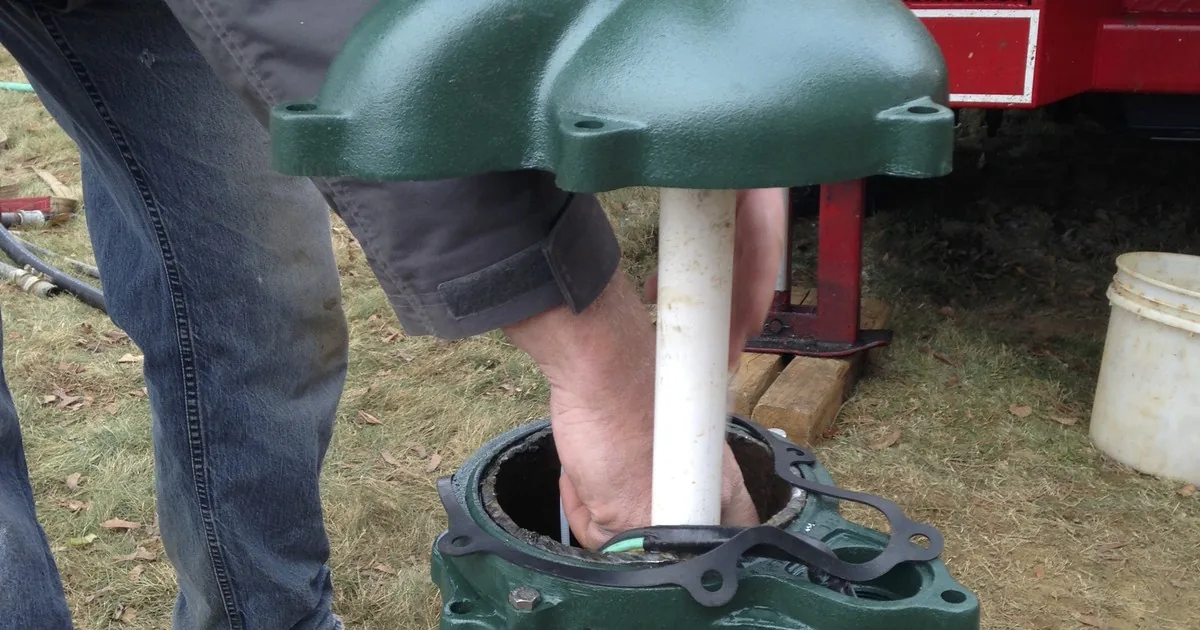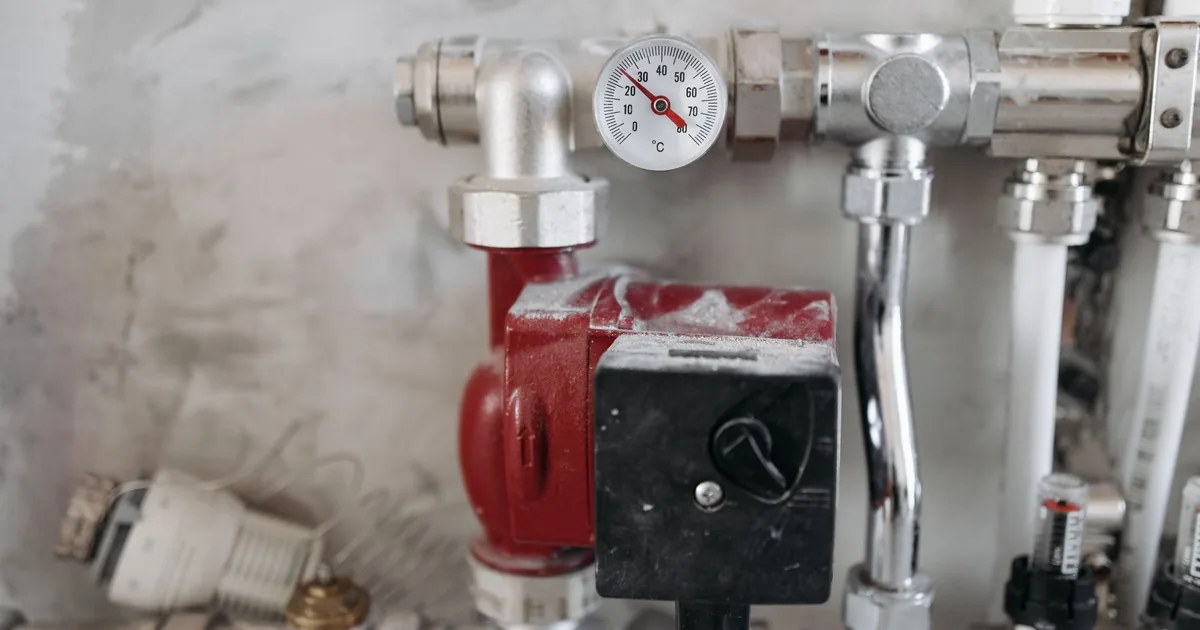
“The pump has been running since breakfast” sounds precise until the call taker asks how the homeowner knows. An aboveground jet pump may be humming in the basement. A submersible pump may be out of sight while a control light stays on. Another caller may simply hear water moving through treatment equipment. Those reports belong in the ticket exactly as observed.
Start by defining “running.” Then screen for zero water pressure, heat, smoke, a burning odor, wet electrical equipment, exposed wiring, or a breaker that will not stay set. Ask what the pressure gauge does and whether any fixture, hose, irrigation zone, livestock waterer, or treatment cycle is using water. Record when the behavior began, what changed beforehand, and where the equipment is located.
Do not name a failed pressure switch, tank, check valve, pump, or well from the phone. Continuous operation can begin at several points in the system, and the same complaint can arrive with very different pressure and water-use patterns.
Define what the caller means by running
Ask the caller to describe the observation without touching or opening equipment. Useful answers include “I can hear the jet pump motor,” “the control box light has stayed on,” “the pipe by the tank is vibrating,” or “the gauge has been stuck below the usual stopping point.” Write down the caller’s words.
For a submersible pump, sound alone may be unreliable because the motor is down the well. The caller may be inferring operation from a control indicator, pressure behavior, water movement, or an electrical monitor. Record the source of that inference. “Pump is running” is a conclusion; “red run light has stayed on for 40 minutes” is an observation a technician can evaluate.
Get a timeline next. Ask when the property last had normal pressure and normal pump cycles. Find out whether the symptom began after a power interruption, plumbing work, a filter change, heavy irrigation, a large water draw, freezing weather, or a repair. The dedicated power-outage recovery guide covers the narrower case where water failed to recover after utility power returned.
Also separate continuous running from rapid starting and stopping. A pump that starts every few seconds belongs in the short-cycling intake workflow. The sound pattern matters.
Screen zero pressure and electrical hazards first
Ask whether water is flowing anywhere on the property. A pump that appears to run while every fixture has zero pressure needs prompt service routing. The office should follow its established shutdown and escalation policy, especially when dry running may be possible. Do not improvise remote repair steps.
Electrical conditions can raise the priority. Ask about smoke, sparks, unusual heat, a burning or hot-insulation odor, standing water near electrical equipment, exposed conductors, a buzzing control, or repeated breaker trips. Nobody should remove a pressure-switch cover, open a control box, test voltage, touch wet equipment, or keep resetting a breaker for the sake of intake. The Goulds Water Technology service manual treats pump service as hazardous-voltage work and requires electrical power controls before technicians proceed.
A visible leak deserves immediate detail too. Ask where the water is appearing, whether it is near wiring, whether it is spraying or pooling, and whether the caller can avoid the area. Follow the contractor’s policy for isolating damage. The office should not tell a caller to operate an unfamiliar valve or disconnect.
The broader no-water emergency call guide covers loss of supply regardless of pump runtime. Use that lane when the caller’s main problem is no water, then add the continuous-running observation to the same record.
Record the pressure pattern without testing live equipment
If a gauge is installed where the caller can read it without approaching a hazard, ask for the current reading and what the needle has done. Has pressure risen, stalled, fallen, bounced, or stayed unreadable? Does it change when all known water use stops? A dirty, damaged, or stuck gauge is possible, so label the number as a caller-reported reading rather than a verified system measurement.
Do not supply a universal “correct” pressure. Systems differ, and a field technician needs the actual switch, tank, pump, elevation, demand, and system design. The useful comparison is often the property’s own normal behavior: “The gauge usually climbs and the pump stops, but today it stays at the same point.”
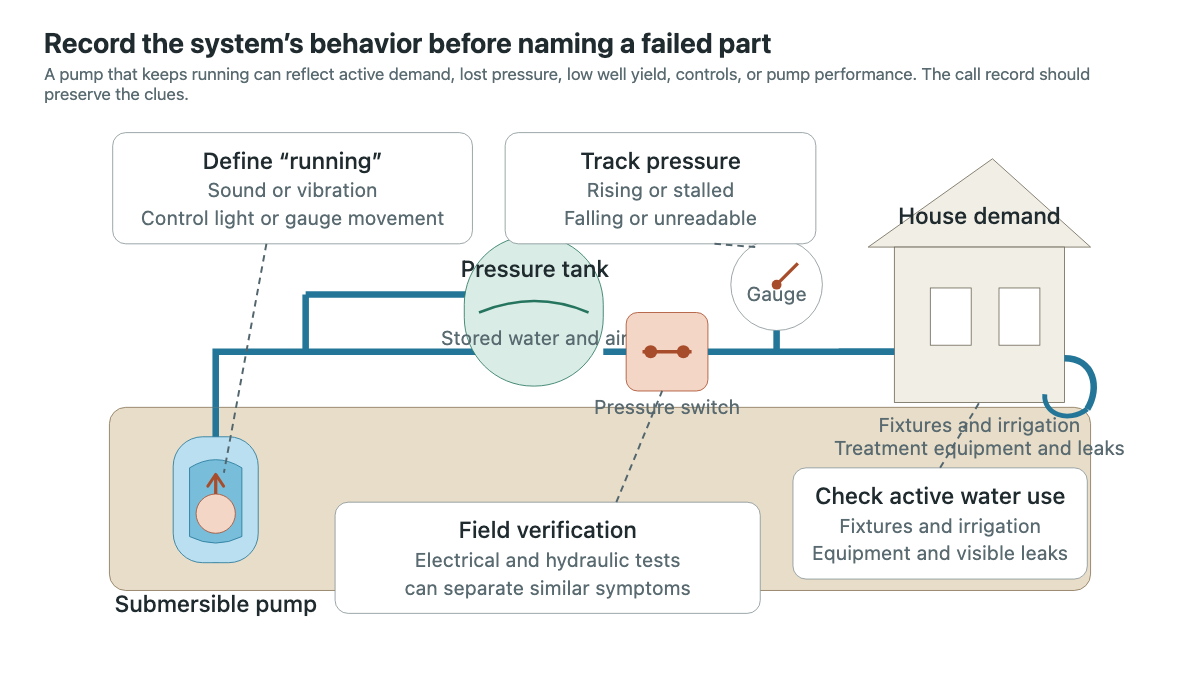
The pressure pattern narrows the field visit without settling the diagnosis. A pump may continue because water is still leaving the system, the system is losing pressure, the well supply is not keeping pace, the pump cannot build the expected pressure, or a control is not responding as intended. InspectApedia’s continuous-running reference lays out these cause categories and warns against letting a no-pressure pump continue unchecked.
Keep the ticket factual: “Gauge reportedly rose from 22 to 34 and remained there for 15 minutes with all known fixtures off.” Do not rewrite that as “weak pump” or “bad switch.”
Account for every place water could still be moving
A pressure-controlled pump is expected to run while the system demands water. The call taker needs a quick property-wide demand check before treating the runtime as unexplained.
Ask about:
- showers, laundry, dishwashers, toilets, and faucets
- outdoor hydrants, hoses, sprinklers, and irrigation zones
- livestock waterers, barns, greenhouses, guest houses, or tenant units
- water softener regeneration, backwashing filters, reverse-osmosis storage, and other treatment equipment
- visible wet ground, running toilets, dripping relief lines, crawlspace water, or an unexplained sound of flowing water
- recent plumbing work, a newly opened seasonal line, or a valve left in a different position
Tie each item to time. “Irrigation ran this morning” is incomplete. Ask when it started, whether it has stopped, which zone was active, and whether the pump behavior changed afterward. A hidden leak remains possible even when the homeowner sees no water, but the office should record that uncertainty instead of sending the caller on a search through unsafe spaces.
Heavy use also belongs beside the well’s known capacity. Penn State Extension explains that well yield and peak demand are different facts. A well may produce water steadily yet struggle to match a concentrated period of household or farm use. That makes recent irrigation, multiple simultaneous fixtures, or a large storage refill relevant service information. It does not prove that the well is failing.
Capture the equipment and system history
Ask whether the system uses a submersible pump, an aboveground jet pump, or a constant-pressure drive, if the caller knows. Collect visible make and model information without asking anyone to remove a cover. Record the pressure-tank location, control-box location, gauge location, treatment equipment, storage tanks, booster pumps, and any separate buildings served by the well.
Photos can help when company policy allows them. Request wide views that show how equipment connects, plus readable labels taken from a safe position. A tight photograph of one gauge may omit the leaking fitting beside it. A wide view alone may make the label unreadable. Leave cabinet interiors and live electrical parts alone.
System records are often more useful than a guessed age. Ask whether the owner has a well completion report, pump installation invoice, past inspection report, recent repair invoice, or water-treatment manual. Penn State Extension’s maintenance guide recommends keeping well construction, pump, inspection, testing, treatment, and repair records because performance changes need a point of reference.
Add access details before choosing a slot: full address, gate code, road condition, wellhead location, tank location, basement or crawlspace access, animals, locked buildings, and the person authorized to approve work. Note whether the property has an essential water need for livestock, medical care, food service, or another operation covered by the contractor’s priority policy.
Read back a dispatch-ready service ticket
A strong handoff sounds like this:
“Caller reports the submersible-pump run light has stayed on since about 7:20 a.m. The pump itself cannot be heard from the house. Water still flows at fixtures but pressure is weaker than normal. The visible gauge reportedly rose to 34 and stayed there after the irrigation controller was turned off under the owner’s normal procedure. No indoor fixtures or treatment cycles are known to be active. There is no visible leak, standing water, smoke, heat, burning odor, exposed wiring, or breaker trip. The pressure tank and gauge are in the basement. The wellhead is behind the barn, and the 2018 pump invoice is available.”
That note tells the technician how operation was inferred, what happened to pressure, which demand was stopped, what hazards were screened, and where to start on arrival. It does not claim the switch, tank, pump, pipe, or well has failed.
An AI receptionist can collect the same sequence after hours if the contractor sets conservative escalation rules and bans live electrical coaching. The best first question remains plain: “What can you see or hear that tells you the pump is still running?”